


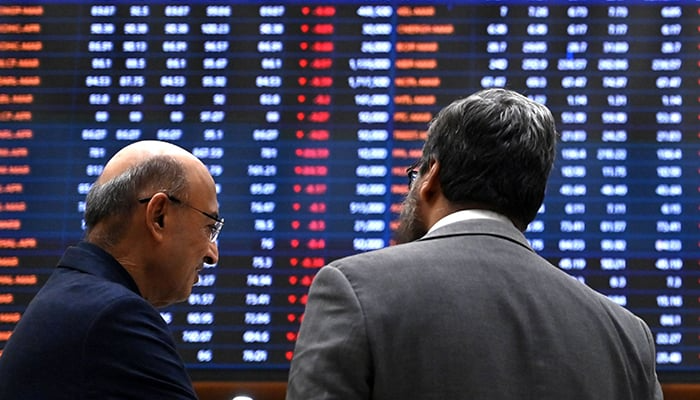
Pakistan’s stock market staged a strong recovery as the Pakistan Stock Exchange (PSX) rebounded sharply following the previous session’s historic selloff. The benchmark KSE-100 Index climbed more than 5,000 points on Tuesday, closing at 157,132.09 points, a gain of 5,159 points or around 3.39 percent. The rebound came after the market experienced its largest-ever one-day drop, when the index plunged over 16,000 points amid heightened geopolitical tensions linked to developments in the Middle East. Market participants described Tuesday’s movement as a technical rebound as investors returned to the market to buy stocks that had become significantly undervalued after the steep decline seen in the previous session.
During the trading session, the benchmark index showed notable volatility but maintained a strong upward trajectory for most of the day. The KSE-100 Index reached an intraday high of 158,217 points, gaining more than 6,200 points or roughly 4.11 percent at its peak. However, the market also saw some temporary pullbacks during the session, touching a low of around 151,258 points earlier in the day. Analysts observed that despite the intraday fluctuations, overall investor sentiment improved as bargain hunters entered the market. Many traders believed that the dramatic decline in the previous session had pushed share prices to attractive levels, encouraging investors to accumulate stocks.
Market experts suggested that the sharp recovery reflected a technical bounce rather than a clear shift in long-term sentiment. According to analysts, the previous day’s selloff had been driven largely by panic selling and heavy liquidation from institutional investors, including mutual funds. Once the immediate pressure eased, investors began returning to the market to take advantage of lower valuations. Financial analysts noted that such rebounds are common following extreme corrections in equity markets. However, they cautioned that the sustainability of the recovery will depend on broader economic conditions and developments in global markets.
Global market sentiment remains an important factor influencing Pakistan’s equity market. International investors are closely monitoring geopolitical developments in the Middle East following military strikes involving the United States, Israel, and Iran. The escalating tensions have created uncertainty in global financial markets and pushed energy prices higher. Rising oil prices can have mixed implications for Pakistan’s economy and its stock market. While energy-related companies may benefit from higher prices, the broader economy may face inflationary pressures if energy costs remain elevated. These global developments continue to influence investor confidence in emerging markets.
Despite the strong rebound, analysts emphasize that volatility may persist in the coming days as investors continue assessing geopolitical risks and global economic signals. Financial markets across Asia have also experienced pressure due to rising uncertainty. Major indices in the region have shown declines as investors weigh the potential impact of prolonged conflict on energy supplies and global trade. For the Pakistan Stock Exchange, the key question remains whether the latest rebound represents the beginning of a sustained recovery or merely a temporary bounce following an unusually sharp correction. Investors are expected to closely monitor geopolitical developments and global market trends before making further investment decisions.